
For the last two years, the tech world has been obsessed with the “Chatbot”—a single, isolated interface that answers questions. But for those of us focused on operationalizing growth for global startups, the single-agent model is hitting a ceiling. It’s a generalist in a world that demands specialists.
The next frontier isn’t just a smarter AI; it’s a Multiagent System (MAS). This is a shift from a single “brain” to a coordinated digital workforce.
The Problem with the Generalist
Standard Large Language Models (LLMs) are essentially solo performers. When you ask a single agent to handle a complex task—like orchestrating a market entry strategy for a startup moving into the Silicon Valley ecosystem—it has to juggle legal compliance, competitive analysis, and cultural nuance all at once.
The result? “Hallucinations” or flat, generic advice that lacks the grit needed for real-world execution.
The Architecture of Collaboration
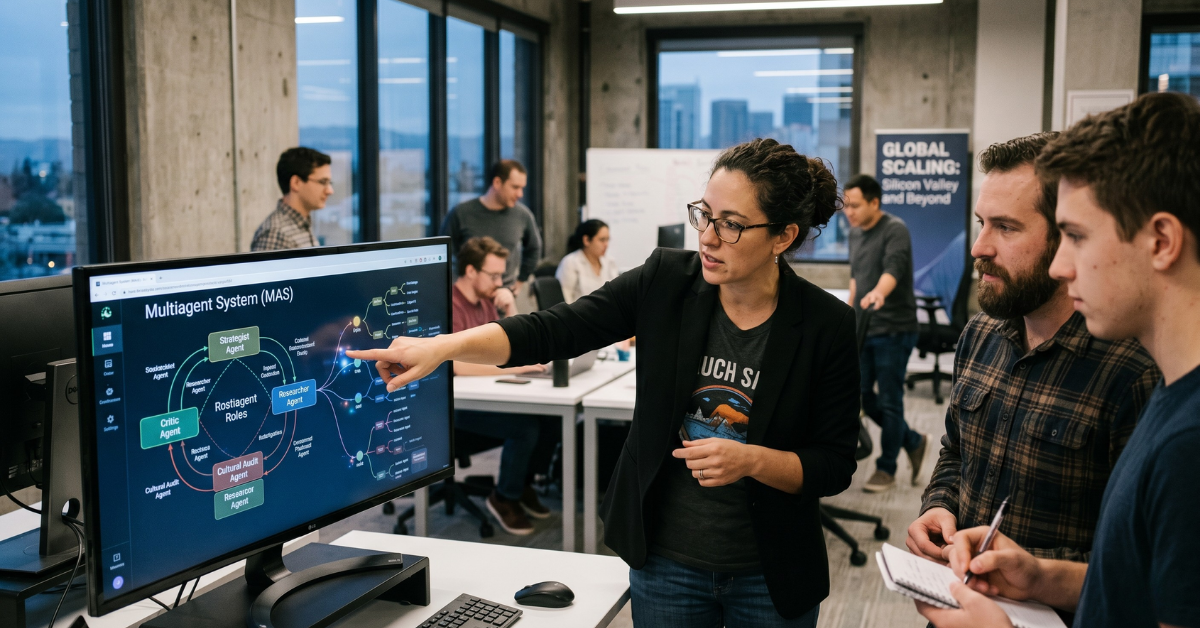
Multiagent systems flip the script. Instead of one model doing everything, MAS breaks a mission down into distinct roles. Think of it like a high-performance startup team:
- The Strategist: Defines the objective and sets the parameters.
- The Researcher: Scours real-time data and APIs to feed the system facts, not just training data.
- The Critic: Acts as a built-in “stress test,” challenging the strategist’s assumptions before anything reaches the human eye.
This isn’t just “more AI.” It is a structured, recursive loop where agents communicate, peer-review, and refine. If the Researcher finds a conflict in localized trade laws, the Critic flags it, and the Strategist pivots—all in milliseconds.
Why This Matters for the GSDVS Portfolio
At GSD Venture Studios, we talk about “Getting Stuff Done.” MAS is the first AI framework that actually lives up to that name.
- Autonomous Operations: We are seeing a move away from “Human-in-the-loop” to “Human-on-the-loop.” MAS can manage entire lead-gen and technical support pipelines across Mesoamerica and Europe without the overhead of a massive headcount.
- Hyper-Localization: One of the hardest parts of scaling is localized intelligence. MAS allows founders to deploy “Cultural Agents” that audit every piece of content against local norms and legalities simultaneously.
- Group Reasoning: By implementing adversarial agents—models specifically designed to argue against a proposal—startups can reach more rigorous, data-backed decisions faster than a human committee ever could.
The Hurdles
It’s not all “plug-and-play.” MAS requires massive computational orchestration. We’re moving toward using Small Language Models (SLMs) as specialized agents to keep costs down and speed up. There’s also the risk of “Agent Drift,” where a feedback loop between agents creates a digital echo chamber.
The Verdict
The era of asking an AI a question and hoping for a good answer is ending. We are entering the era of giving AI a mission and watching a team of agents execute it. For founders, mastering this architecture isn’t a luxury; it’s the prerequisite for scaling in the next decade.