

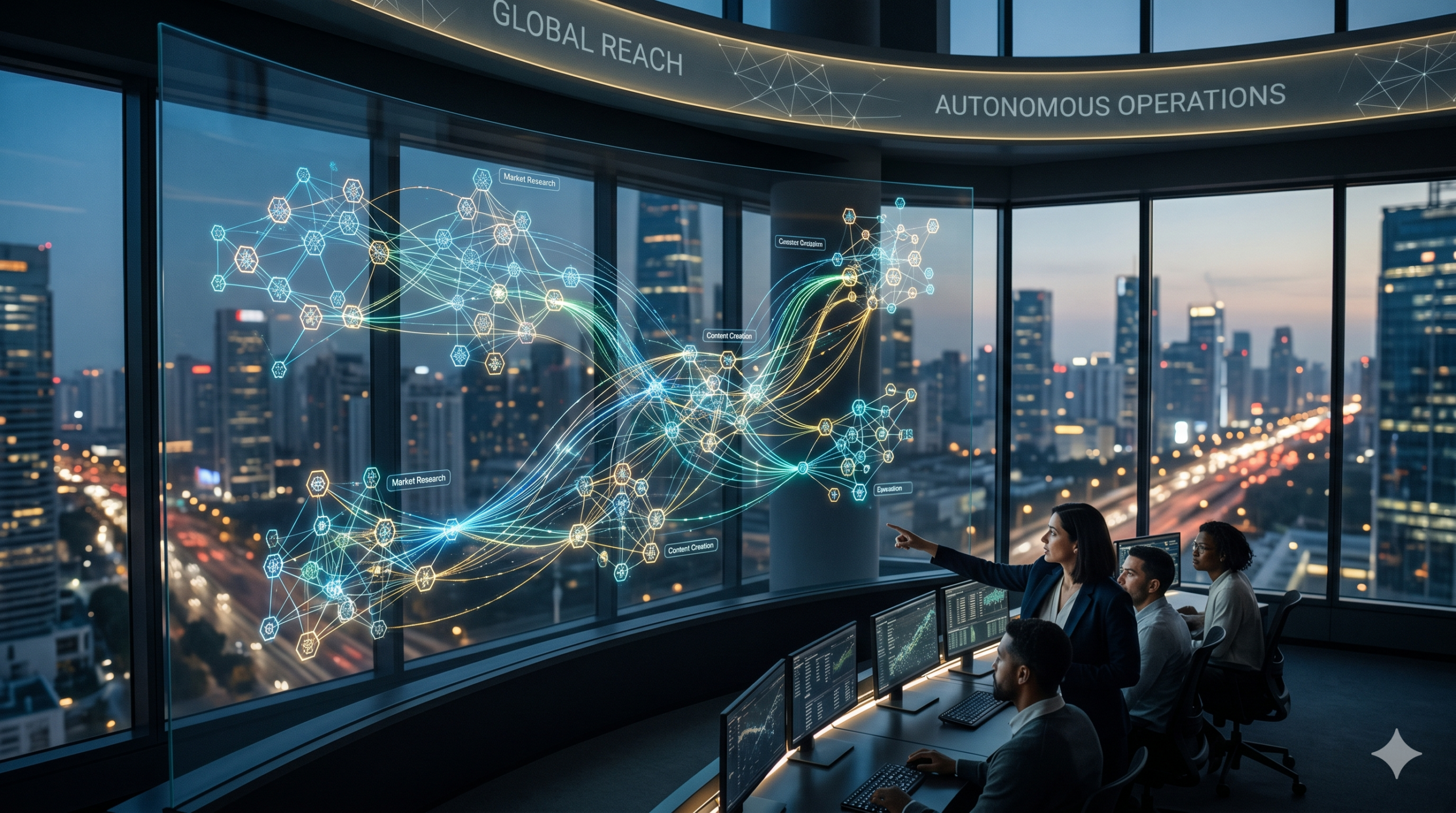
The single-agent AI model has reached its practical ceiling in enterprise scaling. While a single AI assistant can write a blog post or clean a dataset, it still requires constant human prompt engineering, oversight, and hand-offs. To achieve true non-linear scale, high-growth companies are shifting toward AI Swarms—coordinated ecosystems of specialized AI agents that collaborate, self-correct, and execute complex workflows autonomously.
By transition from isolated tools to a collective intelligence network, businesses can scale both backend operations and front-end customer acquisition without a linear increase in headcount or overhead.
What is an AI Swarm?
Unlike a monolithic AI application, an AI swarm is a decentralized network of specialized agents, each optimized for a distinct task. These agents communicate with one another through unified data layers, passing tasks back and forth just like a human departmental team.
A standard growth-focused swarm typically includes:
- The Researcher Agent: Scours regional databases, search trends, and social footprints to identify high-intent market segments.
- The Strategist Agent: Analyzes the researcher’s data to map out targeted messaging angles and channel-specific distribution plans.
- The Creator Agent: Generates localized, high-velocity content variations tailored to those exact segments.
- The Optimizer Agent: Monitors live campaign performance, processes attribution data, and automatically reallocates programmatic deployment parameters to maximize conversion.
Because these agents operate in a continuous feedback loop, the swarm executes, tests, and refines campaigns in minutes—a process that normally takes a human marketing team weeks of meetings and revisions.
Removing the Scaling Bottleneck
The true power of swarm intelligence lies in its ability to eliminate operational drag. In traditional scaling models, entering a new market or launching a massive distribution campaign creates immediate bottlenecks in asset production, lead qualification, and data synchronization.
AI swarms solve this by handling the heavy lifting of execution autonomously:
- Infinite Bandwidth: A swarm can analyze thousands of localized data points and deploy hundreds of targeted distribution loops simultaneously, ensuring your brand achieves instant omnipresence in a new vertical.
- Autonomous Self-Correction: If a specific acquisition loop underperforms, the optimizer agent signals the strategist and creator agents to rewrite and redeploy alternative narratives in real time without human intervention.
- Seamless System Integration: Swarms can bridge the gap between fragmented data stacks, autonomously moving high-intent leads from distribution channels into centralized databases and triggering localized onboarding workflows instantly.
Scaling at pace requires moving past tools that merely assist your team, and adopting systems that can execute autonomously. AI swarms represent the next frontier of operational velocity, turning complex growth strategies into a highly automated, self-sustaining engine. Through the GSDVS Superscaler program, enterprises are deploying these precise agent networks to out-execute competitors and dominate market share with unprecedented speed.